
Truth-Telling Enhancement Training in Pathological Adolescent Liars Using Risk-Free Verbal Operants: An Avoidance-Deceleration Program
Abstract
Chronically severe adolescent prevaricators suffering mild to moderate speech impediments when confronted about lying underwent a two-phase incremental training program aimed at (a): Recruiting their reticent parents for treatment participation, and (b): Replacing avoidance behaviours (i.e., fact-evasion responses) with risk-free (CRF) reporting of facts. Training phase I involved consistency training consisting of verbal responses matching proximal follow-up action by the subjects, the purpose of which was to stimulate initial motivation for parental participation. Training phase II entailed a stepwise or incremental series of fact presentations involving impersonal observations (reporting neutral, positive, negative facts), transitioned to personal observations (neutral, positive and negative facts). Programmed triaging entailed both parent and child through modelling and imitation exercises conducted first within the educational/clinic setting and then practiced in the natural environment for rapid response generalization. System factors considered included the parents’ propensity for anger, which suppresses the child’s truth-telling, and the child’s elimination of avoidance behaviour (lying) when risk-free, fact-statements increased. Results of changing criterion across subjects’ designs yielded significantly increased quantity and frequency of nonpersonal and personal facts that were revealed both under structured prompt conditions and free operant (improptu) conditions. Implications of fact-reporting responses competing against a severe history of avoidance are discussed regarding the advantages of reinforcement over punishment methods for correcting lying.
Applied behaviour analysis; Inter-behaviourism; Lying behaviour; Adolescence; Single case design; Parenting training; Reinforcement; Punishment
INTRODUCTION
Etiology of child avoidance behaviours, also called “lying,” ostensibly traces to three causal variables underlying construction and retention of anxiety [1-4]. First, exposure to aversive stimulation (auditory, visual, tactile, etc.), either occurring predictably or randomly, invokes visceral arousal or “fear”. This fear decreases only after termination of the aversive stimulus. That is, a child “lies” (avoids telling information) when confronted to avoid or escape from imminent verbal or physical punishment. Second, repeated exposure to aversive stimulation invokes anticipatory arousal. Here, children become hypervigilant to surrounding discriminative cues. These cues signal the impending delivery of aversive events, from which they experience equivalent levels of visceral effects. Third, rule governed verbal statements form in response to aversive cues and alone evoke heightened emotional states without actual punishing consequences. For example, a child says to self, “I better not tell dad what I did, or else I’ll get spanked. This self-statement precedes a decision to lie without actually being punished. In combination, anxiety-induced avoidance accounts for a cluster of highly integrative, concurrent and sequential responses impeding a child’s exposure of risk-information [5,6]. Risk-avoidance behaviours further comprise two forms of lying patterns typically found in children and adolescents. The first type consists of self-suppression of verbal behaviour at subvocal or inaudible ranges. Subvocal self-statements can be deleted or replaced to avoid punishment and maximize reinforcement from the listener (parents). This self-editing symptomatically appears as delayed, staggered or stuttered sounds obstructing the speech pattern; the child looks like he or she has a speech impediment. Diminished or “truncated” speech aims to avoid or escape from punishment. The second lying pattern consists of highly fluent, audible and spontaneously delivered statements showing remarkable logical cohesion. Here the child exhibits excessive verbal behaviour inflated to prevent avoid or terminate punishment. In both cases, lying is reinforced negatively by circumventing (avoiding or escaping) aversive parental reactions. Similar avoidance/escape cycles between parent and child appeared in modifying social communication skills [7,8]. More recently, a progressive approach is to include contextual (setting) events as the primary variables modified in correcting adolescent behaviours [9].
Kantor’s conceptualization of lying was similar. He rejected cognitive psychologist condemning lying as a personality flaw, acts of psychopathology, a moral failure or cognitive defect. Instead, lying was an inter-behaviour organized by the field events consisting of the child, stimulus conditions, historical f ield, present setting, medium of contact, child’s disposition. Lying behaviour was functional, insofar as avoiding punishment, gaining approval, reducing conflict, maintaining social standing, protecting another person, or securing access to something desired. In this respect, lying was fundamentally homogenous to child behaviours of exaggerating, pretending, storytelling, impression management, and strategic communication [10,11]. Recognizing lying as developmentally normal or common place among young children adolescents not only depathologizes it, but also shows the behaviour is amenable to reconditioning likened to other inappropriate behaviour treated with conventional interventions such as Differential Reinforcement of Other behaviour (DRO), Differential Reinforcement of Incompatible behaviour (DRI), Differential Reinforcement of Lower rates of behaviour (DRL) and Differential Reinforcement of Higher rates of behaviour (DRH) [12].
Despite this a priori conclusion, applied behavioural research on eliminating lying has been scant, whereas traditional psychotherapies monopolized treatment. Behaviourally, approaches emphasized confinement of the lying incident and subjecting it to (a): Punishment (privilege removal, time-out, restitution and overcorrection, response cost, etc.) (b): Selective reinforcement for occurrences of truth-telling behaviour (e.g., differential reinforcement of other behaviour), or (c): Self-awareness and self-regulation procedures employing self-management methodologies [13,14]. Kodak T et al. for example, calibrated opportunities for children choosing between punishment and random punishment for compliance incentives [15]. Children selected to prevent predictable (versus random) punishment through prompt, accurate responses comprising obedience. Adelinis and Hagopian showed a symmetrical relationship between requested behaviour (“Do’s”) reinforced by immediate consequences, and deviance from requests (“Don’ts”) put on extinction [16]. Verbal promises correlated with follow through behaviours when reinforces were contingent on the say do match; unmatched connections between children’s words and actions went ignored. Self-monitoring protocols recently assailed by Baumeister and Vohs involved truth performance enhancement by raising consciousness of impending punishing and reinforcing consequences [17]. Children processing the emotional and behavioural impact expected from exposure to these consequences modified their lying (avoidance) without adult (parental) intervention.
Nonbehavioral interventions approach lying as a global personality construct manifested for several reasons, ranging from latent passive-aggressiveness to depletion of self-concept [18]. Mediating factors selected as targets for modification include peer pressure, family dynamics, interpersonal malfunctioning and neurobiological factors [19]. From systems to play therapy, the ideographic orientation of changing core emotional and behavioural defects within the child as catalyst to family changes has been highly popular and nearly trumps the obsolete and reductionistic orientation of orthodox operant methods. This said, many of the contemporary theories for lying reversal are unempirical and entirely predicate their outcome on reified, mentalistic concepts or the processes these concepts undergo [20].
One alternative to traditional psychotherapy’s grasp of lying problems is to re-operationalize the target behaviour from “lying” to “fact-reporting.” Where lying involves avoidance, fact-finding involves overcoming avoidance by risk-free (operant) emission of verbal statements under secured CRF schedules. It is possible, in other words, for a child to regenerate verbal fluency, audibility, improvisation of speech and statements revealing negative events, which previously were withheld [14,21,22]. This purpose of this intervention aims to expand a behavioural family systems approach, in reconstructing fact-finding comments that replace lying together with parental participation. Empirically tested is the larger field of reciprocal contingencies between parent and child, simultaneously reducing the child’s avoidance and the parent’s adverse remarks.
METHODS
Participants
Two males (A, B) and one female (C) adolescent ages 11, 13 and 16 respectively, referred by their parents for “lying,” participated in the study. Recruited participants attended public school in a Midwest metropolitan area that was demographically heterogeneous. The Caucasian males resided in the inner city whereas Hispanic female lived in the suburbs. All three adolescents performed academically average in regular courses and partook in at least one extracurricular or community activity. None demonstrated functional communication or social impairments except stuttering and stammering in response to lying confrontation.
Eligibility for participation involved classification of their lying behaviour as (a): Pervasive among people, places and settings (other homes, friends, teachers, school, etc.); (b): Delayed self restraint (self-censorship) in responding to questions confronting their lying; (c): History of collateral (other) avoidance behaviours associated with lying (e.g., never follow through, poor eye contact, unparalleled description of events, placating, etc.) and; (d): Evidence of other fears, phobias or generalizable anxiety. Referring parents consisted of (1) two grandparents raising one male participant (A), (b) a single father raising another male participant (B), and two unmarried cohabiting parents raising the female participant (C). Parenting techniques reported as historically futile on these participants ranged from (a): Angry confrontation; (b): Restitution and overcorrection; (c): Response cost from privileges; and (d): Social embarrassment and guilt induction.
Procedure
Clinical intervention consisted of a multi-componential model frequently employed in applied research conducted in the natural environment [23]. Two training phases compromised the 9-week schedule of consecutive sessions allocated by the parents’ mental health insurance policy, although additional sessions were available upon request. During the intake session, a functional assessment occurred regarding the participants’ lying behaviour relative to parental behaviour. This entailed gathering background (causal) information from participants and parents concerning failed lying remediation efforts, generality of lying, biological and social setting events impacting the family, presence or absence of substance abuse, frequency and magnitude of punishment (e.g., escalative family acrimony, domestic violence, criminal arrests, etc.), and prior medication or nonmedication treatments for lying [24]. Intake steps also included explanation of interventions, signed authorization for clinical and research participation, insurance reimbursement and scheduled dates of training sessions.
Independent variables: Independent variables involved reinforcement schedules (CRFs) replacing random schedules of punishment for lying behaviour. Contingent social verbal reinforcers, in particular, consisted of compliments, praise, recognition of correct answers and reiteration of the participants’ compliance with steps. Affectionate reinforcers were intermittent, contingent and varied from physical touching to opportunities for proximal parental interaction (e.g., sitting together while watching TV). Regrading parental involvement, positively scored answers (i.e., subjects’ statements matching facts) were rated as “plus” on a chart. Recorded plus marks served as social reinforcers hypothesized to increase parental motivation for intra-training homework completion. Dependent variables: Three dependent variables were measured. First, participants’ answers to direct questions about neutral, positive and negative observations that matched what the parent observed earned a plus score. Answers of observations deviating from what the parent saw earned a minus score. Second, measurement occurred of the participants’ verbal delivery (stuttering, spontaneous, subvocal and audible). Parents recorded observations in participant speech on the homework record sheets. Third, measures of the parents’ practice of methods and data-recording efforts were reviewed briefly prior to onset of the next training component. Submission of completed or partially completed forms received therapist praise for efforts attempted.
Design and condition sequence: A single-subject changing criterion treatment design was replicated across three subjects exhibiting lying behaviour [25]. Two training phases and generalization phases after intake assessment accounted for the nine treatment sessions. Phases occurred within the same week for participants, but each participant and their respective parent(s) received training independent of other participants. Phase I training was entitled Baseline and Consistency method. Baseline involved parents’ counting the number of lying occurrences during a five-hour period ranging from after school to the child’s bedtime. They did this either by asking general questions of the participants or asking them to identify objects around the house. Baseline lasted approximately 7 days concurrent with the Consistency Method. The Consistency method entailed (a): The provider, first, soliciting during intake assessment which ritual nighttime activity the participant never performed or shared with his or her parent; (b): Once identified, the participant received instructions to tell the parent the desired activity to do with them at night; (c): Provider contacted the participant by telephone at his or her own home on the first night following day-1 of Phase I training reminding them to follow through with the promised activity; and (d): In the same telephone contact, participants received instructions either to e-mail, text or leave a telephone message for the provider each day, indicating the parents and participant followed-through with the promised activity.
Phase II involved six consecutive training sessions entailing steps of Fact-reporting. Step 1 involved the participant being asked to observe “neutral” objects appearing in the room, which had no relation to the participant. For example, asked of the participant was, “What do you see here that is neutral that has nothing to do with you?” Answers which identified tangible, measurable objects verified by observers received praise and a plus score. Repetition of this series of questions, answers and feedback occurred for the entire training period. Participant and parent received instructions to repeat the same steps practiced in Step 1 in the natural environment until they returned to the office. Procedurally, Steps 1 through 6 followed the same sequence of questions, answers and feedback, except for what participants described. In Step 2, participants observed “positive” features in the room having no relation to him or her. For example, the child saying, “that flower vase is pretty.” In Step 3, participants observed “negative” features in the room having no relation to him or her. For example, the child saying, “the washing machine makes a loud noise.” In Step 4, participants observed neutral features about themselves. For example, the child saying, “I’m wearing a blue shirt.” In Step 5, participants observed positive features about themselves. For example, the child saying, “my hair looks good today.” And, in Step 6, participants observed negative features about themselves ascertained by provider and parent. For example, the child saying, “I got dirt on my pants earlier today.” Structured instructional steps within the training session combined with between-session homework using the same rehearsal exercises as done in training. Homework rehearsal involved practice of neutral, positive and negative observations; in this way, programmed generalization of responses to the natural environment could expedite skill acquisition and retention [26]. Generalization steps occurred for 3 additional training sessions.
RESULTS
Observer reliability
Interobserver reliability was collected by having the provider and parent observe different behaviours in Steps 1 through 6 simultaneously during the in-training sessions. Agreement was calculated by dividing the number of agreements by the total number of observations. Observer-reliability results varied from a low of 86% to a high of 100%. The mean reliability for participant truth-telling observations clustered at 90%. Limited reliability checks prevailed outside the training session. Parents of participants (A) and (C) performed reliability checks using the aforementioned calculations, whereas the parent of participant (B) did not have a second observer with whom to verify accurate response detection.
Analysis of data
Consistency training for parental recruitment: Referral parents clearly stated at the outset of training they were pessimistic toward active therapeutic involvement. Phase I consistency training of having the provider telephonically prompt participants to follow through with promises motivated all three participants (and their parents) after the initial call and during the baseline week. Figure 1 demonstrates the relationship between prompt calls made and response compliance of following-through with parent-child activities. Despite setbacks such as ongoing lying in other areas, committed promises spiked during the week as long as participants returned verbal confirmation of the activities via e-mail, fax or phone calls. Spot-checks interspersed by the provider, by randomly contacting participants telephonically, sustained 100% instructional conformity levels.
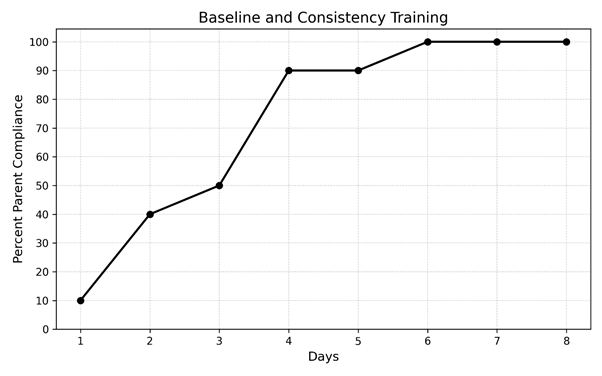
Figure 1: Depicts the percentage of parent compliance when called at night to remind them of procedures to apply during Baseline and Consis tency Training.
Impersonal reporting of facts: Phase II training involving neutral, positive and negative observations (“impersonal information”) showed significant elevations over Baseline period. Shifting criteria from neutral to positive observations represented higher rate increases (e.g., 80% to 100%) than from positive to negative observations. However, progressively accelerated scores appeared within the negative observations as shown in Figure 2.
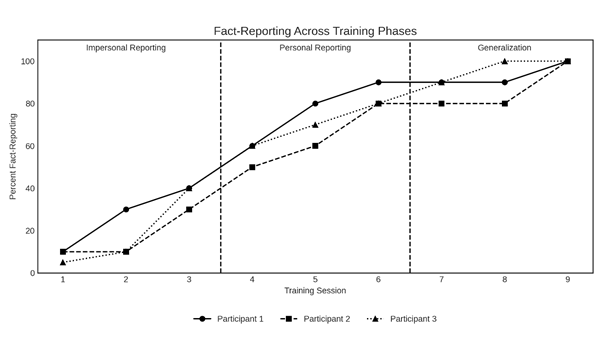
Figure 2: reports percentage of fact reporting as a function of impersonal and then personal reporting, followed by generalization steps.
Note: ( ): Participant 1; (
 ): Participant 2; (
 ): Participant 3
Personal reporting of facts: Transitionally, participants advancing from impersonal (i.e., neutral, positive, negative unrelated to them) statements to observations about themselves (“personal observations”), not surprisingly, recorded elevated and stable scores over baseline. Despite participants’ history of inhibition and lying, observations that accurately described themselves as neutral, negative, and positive progressed steadily higher from 80% to 100%, with no apparent regressions as shown in Figure 2.
Homework completion of rehearsed exercises: Recorded progress of parents applying the techniques (rehearsal of exercises) were recorded by frequency points marked for each occurrence by the parent technique-user. Percentage scores increased proportional to participants’ truth-telling scores. Correct participant answers likely reinforced the parent to repeat the procedure and generate more accurate participant responses as shown in Figure 3.
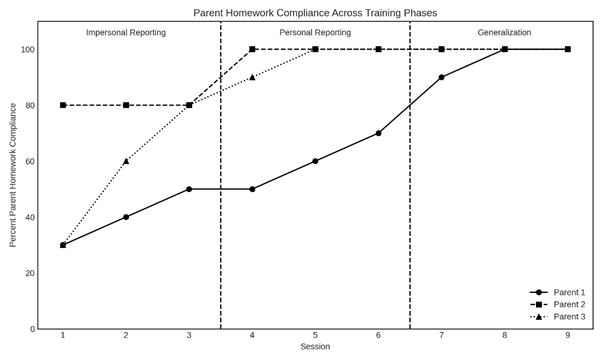
Figure 3: Displays percentage of parent homework compliance across all two phases and generalization.
Note: (): Parent 1; (): Parent 2; (): Parent 3
Generality of training steps across people, settings and behaviour: Installation of generality and maintenance steps was twofold once target behaviour frequency was stable. First, parents applied the techniques of fact-reporting in non-familial house settings including in the community (grocery stores, recreational facilities, extended family homes and friend’s homes). Accuracy and consistency of the applications prompted the maintenance step. Here, parents introduced a list of new contingencies formed as rules for the child to follow. Table 1 lists several of these new contingencies reformulated as rule-governed behaviour [27 30]. Instructions followed that parents prompt their children (participants) to self-state the rules to facilitate spontaneous disclosure of some information (neutral, positive or negative) about the participant. Spontaneous disclosure was to occur prior to the parent asking direct questions of the participant. In this way, the subject’s rule-governed (self-) statements competed with fear statements and established a motivator or establishing operation for avoidance and escape [31]. In other words, the subject “avoided” and “escaped from” the parent’s reminder instruction by self-stating new rules; these new rules prompted (cued) subjects to tell facts (i.e., tell the truth) in return for expecting a high probability of parental reinforcement.
| New contingency | Reformulated rule for child’s self-statement | Behavioral function of the rule |
|---|---|---|
| Parent responds warmly when child reports neutral facts | “When I say regular things that happened, Dad hugs me.” | Increases child’s likelihood of reporting neutral events without hesitation |
| Parent praises and smiles when child reports positive facts | “If I tell good things that happened, Mom kisses me and gets excited.” | Increases child’s sharing of positive events; strengthens approach behavior |
| Parent stays calm and supportive when child reports negative facts | “If I tell something bad that happened, Dad listens and helps me.” | Increases child’s willingness to report negative events without avoidance |
| Parent responds gently when child shares neutral facts about self | “When I talk about myself in normal ways, Mom pays attention to me.” | Increases self-descriptive statements; strengthens flexible self-reporting |
| Parent shows pride when child shares positive facts about self | “If I say good things about myself, Mom smiles and says she’s proud.” | Increases verbalization of positive self-statements; enhances self-esteem behaviors |
| Parent remains accepting when child shares negative facts about self. | “If I say something not-so-good about myself, Dad still cares and helps me fix it.” | Increases child’s ability to verbalize negative self-statements without defensiveness or mumbling (subvocal behaviors). |
Table 1: Presents new contingencies reformulated as rule-governed behaviors for the participants and the hypothesized function of the rule- governed behaviors.
DISCUSSION
The applied interventions of consistency training and fact reporting enhancement training effectively motivated parental involvement and lying reduction across all three subjects. Previously diagnosed as pathological prevaricators, these adolescents engaged in exaggerated avoidance and escape behaviours reified by their parents as oppositional behaviour. Overuse and misapplication of traditional mentalistic disciplines such as grounding, property removal, repeated scoldings and moral condemnation not only were ineffective at correcting lying, but the procedures also escalated parent-child altercations and increased the child’s terror of sharing vulnerable information. By redefining “lying” as avoidance and targeting the desired behaviour as “fact-finding,” parents dropped the “negative connotation” associated with lying. They learned to objectively observe their children as reporters of fact. The methods introduced in this study guided parents to teach their children to be reliable fact reporters. Advantages of this study show the power of simplifying and clarifying behaviour to afford parents control over a seriously disturbing behaviour (“lying’).
CONCLUSION
On the downside, methodologically, this subject sample is small and the single case design used may not control for maturational factors or other behavioural segments impeding on the participant’s lives, for example, what they may learn in community activities like boy scouts or Sunday school at a house of worship contributing to the “virtues” (rule governed behaviours) of telling the truth. Low sample sizes also may forewarn limited generality with same or similar populations; in single case design, however, focus is less on the applicability to homogenous groups than on the causality of the experimental variables demonstrated. That said, future research studies isolating lying or analogous behaviours (cheating, stealing, etc.) may wish to expand the experimental design and consider a larger and more heterogeneously diverse population focused on both parent training and school applications.
REFRENCES
- Boe EE, Church RM. Punishment; Issues and Experiments. Ardent Media. 1968.
- Morris TL, March JS. Anxiety Disorders in Children and Adolescents. Guilf Press. 2004.
- Ruben DH. Avoidance Behavior: Doing Things Out of Fear. Warren H Green. 1993.
- Ruben DH. Treating Adult Children of Alcoholics: A Behavioral Approach. Elsevier. 2000.
- Cortez M. The Truth about Lying: A Behavioral Perspective. Behav Analy Blogs. 2024.
- Stocco CS, Thompson RH, Hart JM, Sorensen-Burnworth R. Behavioral Interventions for Dishonesty and Rule Violations in Children and Adolescents: A Review of the Literature. J Appl Behav Analy. 2021;54:1043-1064.
- Esposito M, Fadda R, Ricciardi O, Mirizzi P, Mazza M, Valenti M. Ins and Outs of Applied Behavior Analysis (ABA) Intervention in Promoting Social Communicative Abilities and Theory of Mind in Children and Adolescents with ASD: A Systematic Review. Behav Sci. 2025;15(6):814.
[Crossref] [Google Scholar] [PubMed]
- Collins IM, Halter F, Schächinger Tenés LT, Lieb R, Meyer AH. A Meta-Analysis of Applied Behavior Analysis-Based Interventions to Improve Communication, Adaptive, and Cognitive Skills in Children on the Autism Spectrum. Rev J Aut Develop Dis. 2025:1-21.
- Ferguson JL, Milne CM. Progress in Moving toward a More Progressive Approach to Applied Behavior Analysis. Int Elec J Elem Educ. 2023;15(3):307-320.
- Kantor JR. Principles of Psychology. Chicago Princ Press. 1924.
- Kantor JR. Interbehavioral Psychology: A Sample of Scientific System Construction. Princ Press. 1959.
- Bogin J, Sullivan L. Overview of Differential Reinforcement of other Behaviors. Nat Prof Develop Cent Aut Spect Dis. 2009.
- Weisz JR, Kazdin AE. Evidence-Based Psychotherapies for Children and Adolescents. Guilf Press. 2010.
- Ruben DH. Bratbusters-Say Goodbye to Tandrums and Disobedience. Wellness Inst. 2002.
- Kodak T, Miltenberger RG, Romaniuk C. The Effects of Differential Negative Reinforcement of other Behavior and Noncontingent Escape on Compliance. J Appl Behav Anal. 2003;36(3):379-382.
[Crossref] Google Scholar] [PubMed]
- Adelinis JD, Hagopian LP. The Use of Symmetrical “Do” and “Don't” Requests to Interrupt Ongoing Activities. J Appl Behav Anal. 1999;32(4):519-523.
[Crossref] [Google Scholar] [PubMed]
- Baumeister RF, Vohs KD. Handbook of Self-Regulation. Guilf Press. 2004.
- Merrell KW. Behavioral, Social and Emotional Assessment of Children and Adolescents. Lawr Erlbaum Assoc Publish. 2003.
- Essau CA. Conduct and Oppositional Defiant Disorders: Epidemiology, Risk Factors and Treatment. Routledge. 2003.
- Sanderson WC. Why Empirically Supported Psychological Treatments are Important. Behav Modif. 2003;27(3):290-299.
[Crossref] [Google Scholar] [PubMed]
- Ruben DH. Effects of Bad Parenting and What to Do About it: Alcoholism, Divorce, Benefits, Punishment and Sex. CreateSpace Indep Publish Plat. 2009.
- Ruben DH. Tantrum Survival Kit: The Definitive Guide to Tantrum Management. Outsk Press. 2014.
- Tharp RG, Wetzel RJ. Behavior Modification in the Natural Environment. Academ Press. 1969.
- O'Neill RE. Functional Assessment and Program Development for Problem Behavior: A Practical Handbook. Pacific Grove. 2015.
- Hersen M. Single-Case Experimental Designs. Int Handbook Behav Modif Ther. 1985:85-121.
- Stokes TF, Baer DM. An Implicit Technology of Generalization1. J Appl Behav Anal. 1977;10(2):349-367.
[Crossref] [Google Scholar] [PubMed]
- Ruben DH. Dangers of Multiplayer Online Gaming: A Behavioral Analysis of Impulsive Driving and Simulation to Reality. J Psychol Ment Heal Persp. 2026;1:1-25.
- Ruben DH. Victim Reversal Syndrome: A Behavioral Analysis of Why Victims of Domestic Abuse Become Abusers. J Clin Rev Case Rep. 2026;11(3):1-18.
[Crossref]
- Malott RW, Hayes SC. Rule Governed Behavior: Cognition, Contingencies and Instructional Control. Springer. 1989.
- Zettle RD. Rule-Governed Behavior: A Radical Behavioral Answer to the Cognitive Challenge. Psychol Rec. 1990;40(1):41-49.
- Michael J. Establishing Operations. Behav Anal. 1993;16(2):191-206.
[Crossref] [Google Scholar] [PubMed]
Author(s) Info
Walden University, 4211 Okemos Road, Okemos MI 48864, United StatesReceived date: 21-Mar-2026, Manuscript No: JMHP-26-165693; Editor Assigned: 24-Mar-2026, Pre QC No: JMHP-26-165693 (PQ); Reviewed: 07-Apr-2026, QC No: JMHP-26-165693; Revised: 14-Apr-2026, Manuscript No: JMHP-26-165693 (R); Published date: 21-Apr-2026
Citation: Ruben DH. (2026) Truth-Telling Enhancement Training in Pathological Adolescent Liars Using Risk-Free Verbal Operants: An Avoidance Deceleration Program. SCICONX J Ment Health Psychiatr.1:2.
Copyright: © 2026 Ruben DH. This is an open-access article distributed under the terms of the Creative Commons Attribution License, which permits unrestricted use, distribution, and reproduction in any medium, provided the original author and source are credited.