Publication Performance in Benign Prostatic Hyperplasia Research between 1991-2024: A Bibliometric Analysis
Abstract
Background: Benign Prostatic Hyperplasia (BPH) is a prevalent condition among aging males, driving extensive research efforts. This study aims to analyse publication performance in BPH studies from 1991 to 2024, utilizing bibliometric indicators to evaluate the scientific landscape.
Methods: The Science Citation Index Expanded (SCI-EXPANDED) of Clarivate Analytics’ Web of Science Core Collection (WoSCC) was used to retrieve BPH-related publications. A “front page” filter was applied to enhance accuracy, identifying a total of 20,813 documents. Six publication and citation indicators were employed to assess productivity and impact.
Results: Articles constituted 74% of the identified documents, with an average of 6.2 authors and 28 citations per publication. The USA led in both publication output and citation impact. Collaborative research demonstrated a higher citation rate compared to single-institution and single-country studies. A substantial number of publications were categorized under the headings of “urology and nephrology.” C.G. Roehrborn emerged as a prominent contributor in BPH research.
Conclusion: This study presents a detailed evaluation of the publication performance of countries, institutions, and authors in BPH research.
BPH; Bibliometric; Citation indicator; Publication indicator, Y-index
INTRODUCTION
Benign Prostatic Hyperplasia (BPH) is a highly prevalent, non malignant enlargement of the prostate gland that commonly affects aging men and is a leading cause of Lower Urinary Tract Symptoms (LUTS) [1,2]. The condition becomes increasingly common with age, with approximately 75% of men over the age of 50 experiencing BPH-related symptoms [3]. Epidemiological data from the American Urological Association (AUA) indicate that by the age of 80, up to 90% of men exhibit histological evidence of BPH [4]. Clinically, BPH is characterized by a range of LUTS [5], including urinary hesitancy, weak stream, incomplete bladder emptying, increased urinary frequency, urgency, and nocturia [6].
The study of BPH has a rich history in the medical literature. Early 20th-century publications, accessible through the Science Citation Index Expanded (SCI-EXPANDED), include studies on BPH origins [7], surgical treatments for prostatic hypertrophy [8,9], the Bottini operation [10,11], surgical issues in prostatic hypertrophy [12], and nursing considerations [13]. The term “benign prostatic hypertrophy” emerged in the 1920s [14], reflecting a growing clinical interest in distinguishing this condition from prostate cancer, which early research also began exploring [14,15]. A significant milestone occurred in 1941 when Huggins and Hodges observed that androgen injections could stimulate prostate cancer, prompting further research into hormonal influences on prostate disease [16].
Research advancements continued in the late 20th century, with Benson et al. [17] introducing Prostate-Specific Antigen Density (PSAD) as a metric to differentiate BPH from prostate cancer by comparing PSA levels to prostate volume. McNeal’s influential studies in the 1980s on prostate zonal anatomy clarified that BPH primarily affects the transition zone, a finding that reshaped diagnostic and therapeutic approaches [18,19]. Further studies examined the age-related development of BPH [1] and outcomes of surgical treatments [20]. In the 2010s, research on prostate growth in BPH [21] underscored the condition’s complex pathogenesis, providing insights that continue to shape contemporary clinical practice.
Bibliometric analyses of laser procedures for treating Benign Prostatic Hyperplasia (BPH) and the 100 most-cited BPH articles have provided valuable insights into research performance in this field [22,23]. In recent years, evaluating publication output and tracking research trends have become essential for assessing scientific progress. Many studies have used citation based metrics to measure research impact and explore topic developments across disciplines [24,25]. One popular metric, TCyear, calculates the total number of citations a publication receives from its publication year through the most recent year, offering a reliable and standardized alternative to traditional citation counts from the Web of Science Core Collection [26]. This approach allows for more accurate comparisons of citation influence across different document types, languages, and research categories, and supports detailed analyses by year, institution, and author [27,28]. Additionally, six distinct publication indicators, including total, independent, and collaborative articles, as well as first-author, corresponding-author, and single author contributions, provide a more detailed view of research productivity and impact [29,30]. Recently, corresponding citation metrics for these indicators have also been introduced to enable comparative assessments of research performance at the country and institutional levels [24]. To improve thematic relevance and reduce the inclusion of irrelevant publications in bibliometric analyses using the Topic (TP) search in the Web of Science Core Collection, the “front page” filter proposed by Ho’s research group in 2011 was introduced. This filter limits eligible documents to those containing target keywords in the title, abstract, or author keywords [31]. Its effectiveness in enhancing thematic accuracy has been demonstrated across various studies, revealing discrepancies of 15% in keloid research [32], 14% in Q fever studies [33], and 15% in temporomandibular disorder research [34].
This study aims to address this gap by conducting a bibliometric analysis of BPH-related publications indexed in the SCI EXPANDED database from 1991 to 2024. The analysis reviews publication performance across multiple dimensions, including document types, languages, Web of Science categories, journals, authorship patterns, and international collaborations. Additionally, citation-based indicators such as TCyear and six publication performance metrics are applied to provide a comprehensive overview of scholarly impact and research development in the BPH field.
MATERIALS AND METHODS
Data source and search strategy
The data utilized in this study were extracted from the SCI EXPANDED database, available through Clarivate Analytics’ Web of Science Core Collection (WoSCC). The dataset was most recently updated on June 23, 2025. Impact factors (IF2024) for journals were obtained from the 2025 edition of Journal Citation Reports (JCR), also released on June 23, 2025. Following the recommendation by Chiu and Ho [35], publications from 2024 were analysed only after the release of the 2024 impact factor to maintain temporal consistency in citation analysis.
To ensure comprehensive coverage of the topic, the search employed the Boolean operator “OR” in conjunction with quotation marks to retrieve documents where at least one specified keyword appeared within the Topic (TS) fields, encompassing the title, abstract, author keywords, and Keywords Plus. The search period extended from 1991 to 2024. Primary search terms included: “prostatic hyperplasia,” “prostate hyperplasia,” “prostatic hypertrophy,” “prostatic enlargement,” “prostate hypertrophy,” and “prostate enlargement.” To enhance the accuracy of the analysis, additional terms were included [36]:
Uncommon terms: “Enlarged prostate gland,” “prostatic growth,” “prostate growth,” “prostatic hypertrophic,” “prostatic adenoma,” “enlarged prostatic gland,” “enlarged prostatic glands,” “prostate hypertrophies,” “prostatic hypertrophies,” “prostate adenoma,” “noncancerous prostate gland,” and “noncancerous prostatic glands”.
Misspelling terms: “Prostatic hypertrophia,” “prostate hypertrophia,” “prostatic hyperplasis,” “prostata hypertrophy,” “prostatit hyperplasia,” and “prostatitc hypertrophy;” and terms with spacing errors: “Prostatic hyperplasialbenign” were also considered.
A total of 23,313 documents were retrieved using these criteria, of which 23,239 (99.7%) were published between 1991 and 2024. These records, along with their annual citation data, were downloaded from the SCI-EXPANDED database and processed in Microsoft Excel 365 for further bibliometric coding [37,38]. After applying the “front page” filter [31], 20,813 (90% of 23,239) documents were identified as relevant literature on benign prostatic hyperplasia.
In alignment with WoSCC’s protocol, the reprint author was designated as the corresponding author [39]. For single-author papers lacking corresponding author identification, the lone author was assumed to fulfill both first and corresponding authorship roles. Similarly, single-institution and single-country studies were categorized accordingly [30]. In multi-author papers with multiple corresponding authors, all affiliated authors, institutions, and countries were credited [30].
To ensure consistency in geographical representation, various national and regional affiliations were standardized. The United Kingdom category included publications from England, Scotland, Wales, Northern Ireland (North Ireland), and the British Virgin Islands (British Virgin Isl) [35]. Türkiye was normalized as Turkey [40], while historical listings such as Hong Kong (pre 1997), Netherlands Antilles (Neth Antilles), Faroe Islands, and Yugoslavia were checked and reclassified as China [41], the Netherlands [42], Denmark [43], and Serbia [44], respectively.
Institutional affiliations were also unified where necessary. For instance, multiple campuses of the Mayo Clinic, including those in Rochester, Phoenix, Scottsdale, Jacksonville, and Mankato, were consolidated under the standardized name “Mayo Clinic” [45].
Three primary citation indicators were adopted for evaluation:
Cyear : Number of citations received from the WoSCC in a specific year, e.g., C2024 represents citations in 2024 [46].
TCyear : Cumulative citations from the WoSCC from publication to the end of 2024, e.g., TC2024 [26].
CPPyear : Citations per publication, calculated as CPPyear=TCyear/ TP, where TP is the total number of publications [47].
These indicators were analyzed across various dimensions, including document type, language, WoS category, journal, country, institution, author, and year.
Six publication metrics were applied to assess productivity and collaboration at both country and institutional levels [29]:
TP: Total number of publications.
IP: Independent Publications by a single Country (IPC) or Institution (IPI).
CP: Internationally (CPC) or inter-institutionally (CPI) collaborative publications.
FP: First-author publications.
RP: Corresponding-author publications.
SP: Single-author publications.
Each of these metrics was further evaluated using the CPP2024 to determine the relative impact [24].
To assess individual author performance, the Y-index, developed by Ho’s research group, was applied [46,48]. The Y-index consists of two parameters: Y-index (j, h)
j: Indicates publication potential based on the combined number of FP and RP.
h: Represents the ratio of RP to FP, defined as a polar angle.
Interpretation of the Y-index includes:
h=π/2: Author has only RP publications.
π/2>h>π/4: RP exceeds FP.
h=π/4: Equal numbers of FP and RP.
π/4>h>0: FP exceeds RP.
h=0: Author has only FP publications.
This metric provides nuanced insights into an author’s role and contribution patterns across publications.
RESULTS AND DISCUSSION
Characteristics of document types and languages
To evaluate the distribution and impact of different document types in the field of Benign Prostatic Hyperplasia (BPH), two key indicators were used: The average number of citations per publication (CPP2024) and the average number of Authors Per Publication (APP), as suggested by Monge-Nájera and Ho [49]. A total of 20,813 publications related to BPH, spanning 20 document types, were indexed in the SCI-EXPANDED database between 1991 and 2024 (Table 1).
| Document type | TP | % | TP* | APP | CPP2024 |
|---|---|---|---|---|---|
| Article | 15,358 | 74 | 15,341 | 6.2 | 28 |
| Meeting abstract | 2,034 | 10 | 1,966 | 6.1 | 0.26 |
| Review | 1,785 | 8.6 | 1,785 | 4.5 | 32 |
| Editorial material | 1,077 | 5.2 | 1,033 | 1.8 | 2 |
| Proceedings paper | 583 | 2.8 | 583 | 4 | 36 |
| Letter | 380 | 1.8 | 359 | 2.8 | 1.6 |
| Note | 75 | 0.36 | 75 | 5.4 | 77 |
| Correction | 66 | 0.32 | 63 | 5.9 | 2.5 |
| Retracted publication | 36 | 0.17 | 36 | 6.2 | 19 |
| Early access | 31 | 0.15 | 31 | 7 | 2.4 |
| News item | 13 | 0.062 | 4 | 1 | 0 |
| Book chapter | 9 | 0.043 | 9 | 2.8 | 37 |
| Reprint | 7 | 0.034 | 7 | 5.7 | 47 |
| Addition correction | 6 | 0.029 | 6 | 3.8 | 1 |
| Retraction | 6 | 0.029 | 5 | 6.8 | 0.17 |
| Discussion | 4 | 0.019 | 4 | 6 | 2.8 |
| Publication with expression of concern | 2 | 0.01 | 2 | 9 | 28 |
| Book review | 1 | 0.0048 | 1 | 1 | 0 |
| Expression of concern | 1 | 0.0048 | 1 | 4 | 0 |
| Withdrawn publication | 1 | 0.0048 | 1 | 2 | 19 |
| Note: TP: Total number of Publications; TP*: Total number of Publications with author information in the SCI-EXPANDED; APP: Average number of authors Per Publication; CPP2024: Average number of citations per publication (TC2024/TP); TC2024: Total number of citations from Web of Science Core Collection since publication year to the end of 2024. | |||||
Table 1: Citations and authors according to the document type.
Among these, 15,358 (74%) documents were classified as articles, with an APP of 6.2 authors per publication. Although relatively rare, “notes” (75 publications) had the highest citation impact, with a CPP2024 of 77 citations per publication. This unusually high average is primarily attributable to a seminal paper: “The American Urological Association symptom index for benign prostatic hyperplasia” by Barry et al. [50], which alone garnered 2,909 citations (TC2024). This landmark study introduced the widely adopted AUA Symptom Index, a clinically validated tool for assessing BPH severity, and remains the most cited publication in the field.
Review articles in BPH had a CPP2024 that was 1.1 times higher than that of regular articles. However, this citation advantage was modest compared to other medical domains. For example, the review-to-article citation ratio was 2.7 in Q fever research [33], 1.7 in temporomandibular disorders [34], 1.4 in AI and machine learning applications in kidney care [38], and 1.3 in fracture non-union studies [51].
Across the BPH literature, five “classic” publications (defined as TC2024 ≥ 1,000) were identified [52], including three articles, one review, and one note. The most cited review article, “Biologically active dihydropyrimidones of the Biginelli-type: A literature survey” by Kappe [53], received 1,455 citations. Although the study primarily explored pharmacologically active compounds, BPH appeared as a relevant keyword.
Beyond articles and reviews, the dataset included 1,785 meeting abstracts published in 117 journals, with The Journal of Urology alone accounting for 797 abstracts (45%), often associated with the American Urological Association’s Annual Meeting. These meeting abstracts reflect the dynamic and ongoing dialogue in the BPH research community.
Different document types serve distinct roles in scholarly communication. Articles, typically structured with sections such as introduction, methods, results, and discussion, are the most common and are central to bibliometric evaluations [54]. However, documents in the WoSCC can be assigned multiple classifications. For instance, among the retrieved articles, some were also categorized as: Proceedings papers (583), retracted publications (36), early access papers (21), book chapters (4), expressions of concern (2), and even one withdrawn publication. As a result, cumulative totals in Table 1 may exceed 100%, due to overlapping document type assignments [55].
Articles were published in 16 languages, with English overwhelmingly dominant: 14,734 publications (96%). Other languages included French (245 articles), German (195), Spanish (124), and smaller counts in Portuguese, Chinese, Russian, Italian, Turkish, Japanese, Serbian, Korean, Polish, Greek, Lithuanian, and Slovenian. One article in Chirurgia was listed with unspecified language. English-language articles were more impactful in terms of citations, with a CPP2024 of 29 citations per publication, compared to just 4.0 for non-English articles. Similarly, authorship patterns differed, with English-language papers averaging 6.3 authors per publication, versus 4.7 for non English documents. This discrepancy suggests that international collaboration and visibility, both more common in English publications, are correlated with higher citation performance.
Characteristics of publication outputs
In 2013, Ho introduced a bibliometric approach that evaluates research trends and impact by examining the relationship between the annual number of Publications (TP) and the average number of citations per publication per year (CPPyear) [47]. This method has since gained traction in a variety of medical f ields, including research on dengue [56], breast reconstruction [57], and the application of artificial intelligence and machine learning in nephrology [38].
Between 1991 and 2024, a total of 15,358 articles related to Benign Prostatic Hyperplasia (BPH) were indexed in the SCI EXPANDED. These articles collectively yielded a CPP2024 of 28 citations per publication. The most frequently cited article in this dataset received 1,431 citations. Figure 1 presents the annual article trends and corresponding CPP2024 values for BPH-related articles during this period. As is well established, citation accumulation is time-dependent. For instance, the 670 articles published in 2024 received 701 citations by the same year, resulting in a CPP2024 of only 1.0 citations per publication. In contrast, the 418 articles published in 2007 amassed 16,773 citations by 2024, equating to a CPP2024 of 40 citations per publication. The highest annual CPP2024 occurred in 2003, with 394 articles achieving an average of 53 citations each. This notable peak is largely attributable to the article of two highly cited studies: McConnell et al. [58], which investigated the long term efficacy of doxazosin, finasteride, and combination therapy in BPH treatment and ranked first with 1,431 citations; and Rosen et al. [59], which examined lower urinary tract symptoms and sexual dysfunction in aging males, ranking tenth with 853 citations.
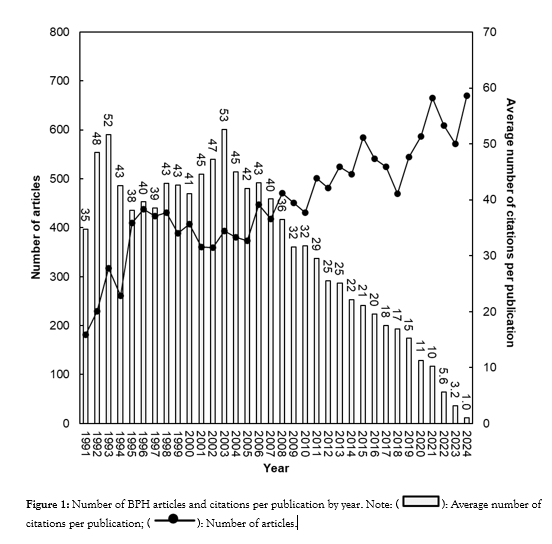
As shown in Figure 1, the CPP2024 metric appears to stabilize approximately 18 years after publication. This indicates a relatively long citation lifespan for BPH-related research, in contrast to other medical research domains, such as breast reconstruction [57], dengue [56], Q fever [33], and temporomandibular disorders [34], where citation maturity is typically reached within a decade.
The early 1990s witnessed rapid growth in BPH research output, with annual articles increasing from 181 in 1991 to 438 in 1996. This expansion coincided with major scientific and clinical advancements. Before the 1990s, Transurethral Resection of The Prostate (TURP) was the predominant treatment for BPH. However, the emergence of less invasive alternatives during the 1990s spurred a wave of comparative studies and multicenter clinical trials. The approval of novel pharmacological agents, including α-blockers (e.g., terazosin) and 5-alpha-reductase inhibitors (e.g., finasteride), provided non-surgical treatment options that garnered considerable clinical and research interest.
Although annual article output fluctuated in the years that followed, the overall trend remained upward, reaching 670 articles in 2024. By the early 2000s, a deeper understanding of BPH pathophysiology shifted the research focus from basic disease awareness to epidemiological studies, therapeutic strategies, and large-scale clinical trials. The subsequent introduction and evaluation of second-generation α-blockers and minimally invasive interventions, such as laser HoLAP, Rezūm, and UroLift, further stimulated research activity. Additionally, the 2000s saw increasing international contributions, reflecting the global relevance and collaborative nature of BPH research. Overall, these patterns demonstrate sustained and progressive growth in the BPH research landscape over the past three decades.
Web of Science category and journal
In 2024, the Journal Citation Reports (JCR) indexed a total of 9,440 journals across 178 Web of Science (WoS) categories within the SCI-EXPANDED. Previous bibliometric studies [24,51] have demonstrated the utility of two core indicators, citations per publication per WoS category (CPPyear) and average number of Authors Per Publication (APP), in characterizing research output across WoS categories. For Benign Prostatic Hyperplasia (BPH), 1,868 journals published relevant articles, which were distributed among 132 WoS categories. Table 2 lists the ten most productive categories. Among them, urology and nephrology were the leading category, comprising 90 journals in 2024 and accounting for 7,411 articles, or approximately 48% of all 15,358 BPH-related articles. Although the oncology category included a larger number of journals (240), it contributed only 1,585 articles. Nevertheless, it recorded the highest citation impact, with a CPP2024 of 41 citations per publication. The cell biology category, while publishing just 449 BPH-related articles, exhibited the highest APP, averaging 7.4 authors per publication.
| Web of Science category | No. Journals | TP (%) | APP | CPP2024 |
|---|---|---|---|---|
| Urology and nephrology | 134 | 7,411 (48) | 5.9 | 29 |
| Oncology | 326 | 1,585 (10) | 7.2 | 41 |
| Endocrinology and metabolism | 193 | 1,171 (7.6) | 6.5 | 37 |
| Pharmacology and pharmacy | 353 | 1,035 (6.7) | 5.7 | 18 |
| General and internal medicine | 333 | 904 (5.9) | 5.9 | 23 |
| Biochemistry and molecular biology | 320 | 646 (4.2) | 7 | 28 |
| Research and experimental medicine | 195 | 569 (3.7) | 6.6 | 16 |
| Radiology, nuclear medicine and medical imaging | 214 | 464 (3.0) | 6.9 | 33 |
| Cell biology | 204 | 449 (2.9) | 7.4 | 35 |
| Pathology | 90 | 384 (2.5) | 6.4 | 31 |
| Note: TP: Total number of articles; %: Percentage of articles in all BPH articles; APP: Average number of authors Per Paper; CPP2024: Average number of citations per paper (TC2024/TP). | ||||
Table 2: The top 10 most productive Web of Science categories in SCI-EXPANDED.
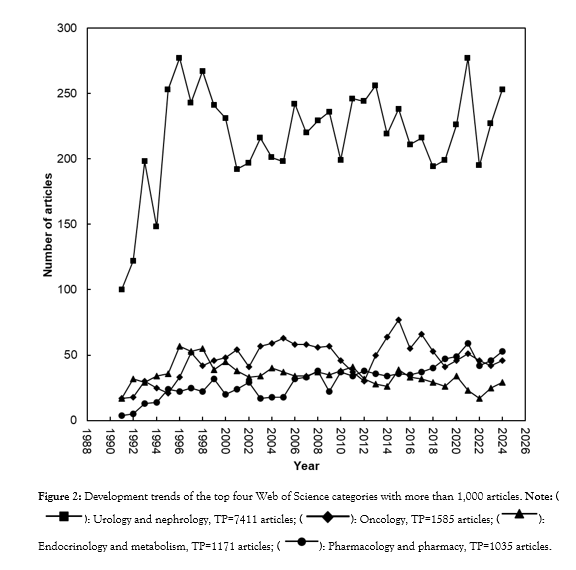
Figure 2 presents the annual article trends in the top four WoS categories with over 1,000 BPH-related articles. The bulk of the research was concentrated in urology and nephrology, followed by oncology. The endocrinology and metabolism category exhibited a slight decline in article output, whereas a modest increase was observed in pharmacology and pharmacy.
Ho further emphasized the importance of CPPyear and APP as key indicators for evaluating journal performance within specific research domains [60]. For BPH-related research, Table 3 highlights the ten most productive journals, along with their 2024 impact factor (IF2024), CPP2024, and APP. All ten journals are classified under the urology and nephrology category.
| Journal | TP (%) | IF2024 | APP | CPP2024 |
|---|---|---|---|---|
| Journal of urology | 981 (6.4) | 6.8 | 6 | 58 |
| Urology | 826 (5.4) | 2 | 6.1 | 39 |
| BJU international | 694 (4.5) | 4.4 | 5.5 | 36 |
| Prostate | 683 (4.4) | 2.5 | 6.7 | 35 |
| European urology | 511 (3.3) | 25.2 | 5.4 | 52 |
| World journal of urology | 385 (2.5) | 2.9 | 7 | 17 |
| Journal of endourology | 346 (2.3) | 2.8 | 5.8 | 18 |
| Urologia internationalis | 248 (1.6) | 1.3 | 5.9 | 12 |
| International journal of urology | 190 (1.2) | 2.2 | 6.8 | 16 |
| Progres en urologie | 167 (1.1) | 1.1 | 5.5 | 6 |
| Note: TP: Total number of articles; %: Percentage of articles in all BPH articles; IF2024: Journal impact factor in 2024; APP: Average number of authors per article; CPP2024: Average number of per paper (TC2024/TP). | ||||
Table 3: The top 10 most productive journals.
The Journal of Urology (IF2024=6.8) emerged as the most prolific journal, contributing 981 articles (6.4% of the total). It also achieved the highest citation impact, with a CPP2024 of 58 citations per publication. The journal’s status as the official publication of the American Urological Association (AUA), the leading global professional body for urologists, likely contributes to its high visibility and citation rates. Articles published in this journal are frequently cited in research studies, incorporated into clinical guidelines, and used in medical education, making it a preferred source for both academic and clinical urologists. The journal Urology (IF2024=2.0) ranked second, publishing 826 articles (5.4%). In contrast, Progrès en Urologie (IF2024=1.1) published 167 BPH-related articles but recorded a lower citation impact, with a CPP2024 of 5.6 citations per publication. Patterns of authorship also varied across journals. The World Journal of Urology had the highest APP at 7.0 authors per publication, while European Urology recorded the lowest, with an APP of 5.4.
Although two of the highest-impact journals in SCI-EXPANDED, The Lancet (IF2024=88.5) and the New England Journal of Medicine (IF2024=78.5), are categorized under general and internal medicine, their limited yet notable contributions to BPH (three and eight articles, respectively) highlight the broader clinical significance of BPH research. These high-profile articles reinforce the relevance of BPH as a topic of interest that extends beyond specialty journals to attract attention from the broader medical and scientific communities.
Publication performances: Countries
It is widely acknowledged that the first and corresponding authors typically make the most substantial contributions to a research article [61]. At the institutional level, the corresponding author’s affiliation is often regarded as the origin or “home” of the study [46]. Among the 15,358 BPH-related articles indexed in SCI-EXPANDED, only 40 (0.26%) lacked affiliation data. The remaining 15,318 articles were authored by researchers affiliated with institutions across 131 countries. Of these, 12,671 (83%) were single-country articles, originating from 104 countries and achieving an average of 26 citations per publication (CPP2024). In contrast, internationally collaborative articles (n=2,647; 17%), spanning 124 countries, demonstrated a higher citation impact, with a CPP2024 of 37. These findings underscore the positive influence of international collaboration on research visibility and impact in BPH research.
To evaluate country-level performance, six standard bibliometric indicators, Total articles (TP), Independent articles (IPC), Collaborative Articles (CPC), First-author articles (FP), Corresponding-author articles (RP), and Single-author articles (SP), were applied to the top 10 most productive countries, including the G7 nations (USA, Germany, Japan, UK, Italy, France, Canada) and three additional major contributors (China, South Korea, Turkey) (Table 4) [24].
| Country | TP | TP (n=15,318) |
IPC (n=12,671) | CPC (n=2,647) | FP (n=15,318) | RP (n=15,232) | SP (n=691) | ||||||
|---|---|---|---|---|---|---|---|---|---|---|---|---|---|
| R (%) | CPP2024 | R (%) | CPP2024 | R (%) | CPP2024 | R (%) | CPP2024 | R (%) | CPP2024 | R (%) | CPP2024 | ||
| USA | 4524 | 1 (30) | 45 | 1 (25) | 46 | 1 (52) | 43 | 1 (24) | 47 | 1 (25) | 46 | 1 (38) | 37 |
| China | 1954 | 2 (13) | 14 | 2 (13) | 12 | 6 (12) | 23 | 2 (12) | 13 | 2 (12) | 13 | 16 (1.2) | 14 |
| Germany | 1122 | 3 (7.3) | 34 | 4 (5.0) | 30 | 3 (18) | 40 | 4 (5.4) | 31 | 4 (5.4) | 29 | 4 (6.5) | 11 |
| Japan | 1092 | 4 (7.1) | 25 | 3 (7.2) | 21 | 10 (6.9) | 41 | 3 (6.5) | 22 | 3 (6.5) | 22 | 10 (2.0) | 14 |
| UK | 1003 | 5 (6.5) | 40 | 7 (4.0) | 35 | 2 (19) | 45 | 7 (4.5) | 39 | 7 (4.6) | 39 | 3 (7.7) | 28 |
| Italy | 983 | 6 (6.4) | 33 | 6 (4.7) | 26 | 4 (15) | 44 | 5 (5.0) | 27 | 5 (5.1) | 26 | 5 (3.6) | 12 |
| South Korea | 731 | 7 (4.8) | 13 | 5 (5.0) | 12 | 18 (3.7) | 20 | 6 (4.6) | 12 | 6 (4.6) | 12 | 21 (0.72) | 8.4 |
| France | 728 | 8 (4.8) | 27 | 8 (3.5) | 17 | 7 (11) | 42 | 8 (3.5) | 19 | 8 (3.6) | 19 | 2 (8.1) | 6.9 |
| Canada | 548 | 9 (3.6) | 41 | 15 (1.4) | 40 | 5 (14) | 41 | 10 (2.2) | 35 | 10 (2.2) | 35 | 8 (2.6) | 21 |
| Turkey | 489 | 10 (3.2) | 14 | 9 (3.5) | 13 | 25 (1.9) | 24 | 9 (3.0) | 13 | 9 (3.0) | 13 | 21 (0.72) | 11 |
| Note: TP: Number of total articles; TPR (%): Total number of articles and the percentage of total articles; IPCR (%): Rank and percentage of single-country articles in all single-country articles; CPCR (%): Rank and percentage of internationally collaborative articles in all internationally collaborative articles; FPR (%): Rank and the percentage of first-author articles in all first-author articles; RPR (%): Rank and the percentage of corresponding-author articles in all corresponding-author articles; SPR (%): Rank and the percentage of single-author articles in all single-author articles; CPP2024: Average number of citations per publication (CPP2024=TC2024/TP). | |||||||||||||
Table 4: Top 10 productive countries.
The United States led across all six indicators, contributing 4,524 articles (30% of 15,318 total), 3,139 independent articles (25% of 12,671), and 1,385 collaborative articles (52% of 2,647). Additionally, the U.S. produced 3,719 first-author articles (24%), 3,743 corresponding-author articles (25% of 15,232), and 265 single-author articles (38% of 691). The U.S. also exhibited the highest citation impact, with CPP2024 values of 45 (TP), 46 (IPC), 47 (FP), 46 (RP), and 37 (SP). Notably, U.S.-based researchers authored 11 of the 14 most cited BPH related articles. The United Kingdom, while ranking lower in overall output, had the highest CPP2024 (45) for internationally collaborative articles (CPC=690). In contrast, non-G7 countries such as China, Turkey, and South Korea showed lower citation impact across most indicators.
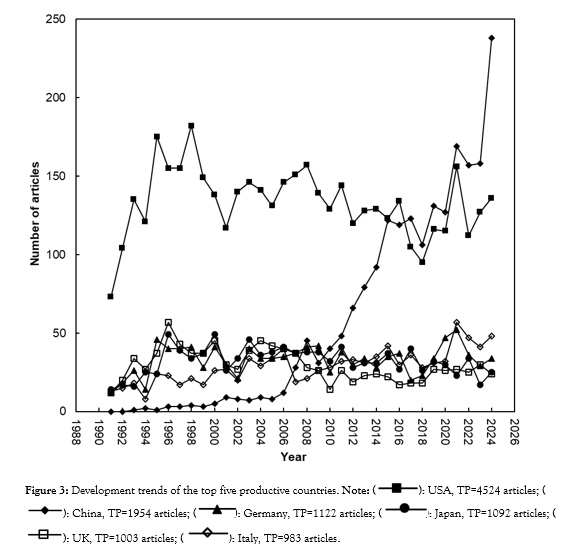
Figure 3 depicts longitudinal article trends for the five most productive countries. The United States maintained dominance in BPH research output from 1991 until 2016. China, although a late entrant, demonstrated exponential growth, from one article in 1993 to 12 in 2006, peaking at 123 in 2017, and has been the leading contributor since then. By 2024, Italy (ranked 3rd), South Korea (4th), and India (6th) contributed 48, 47, and 30 articles, respectively. These trends coincide with global demographic shifts, especially in aging populations, and increasing healthcare burdens associated with BPH. Countries like China, South Korea, and India have responded with increased research funding, academic incentives, and an emphasis on international article, resulting in a rise in both output and visibility in indexed journals.
Publication performances: Institutions
At the institutional level, 5,932 articles (39%) were authored within single institutions (CPP2024=25), whereas 9,386 articles (61%) resulted from inter-institutional collaborations, which yielded a higher CPP2024 of 31 citations per publication. These results further emphasize the positive association between collaboration and research impact. Table 5 presents the ten most productive institutions in BPH research, as evaluated using Ho and Mukul’s six publication indicators [24]. Among them, seven are based in the United States, while Canada, China, and South Korea each contributed one. The Mayo Clinic (USA) led in five of six metrics: Total articles (TP=288; 1.9%), single-institution articles (IPI=67; 1.1% of 5,932), inter-institutional collaborations (CPI=221; 2.4% of 9,386), first-author articles (FP=157; 1.0%), and corresponding-author articles (RP=137; 0.92% of 14,968). The University of Texas (USA) led in single-author articles, contributing 19 articles (2.7% of 691). Although Shanghai Jiao Tong University (China) tied for first in corresponding-author articles (RP=137), its CPP2024 remained significantly lower compared to U.S.-based institutions. In contrast, the University of Texas demonstrated the highest CPP2024 values among the top institutions: 98 (TP), 115 (CPI), 87 (FP), and 86 (RP). Authors from the University of Texas were involved in four of the ten most cited BPH-related articles, serving as first or corresponding authors in all four cases.
| Institute | TP | TP (n=15,318) | IPI (n=5,932) | CPI (n=9,386) | FP (n=15,318) | RP (n=14,968) | SP (n=691) | ||||||
|---|---|---|---|---|---|---|---|---|---|---|---|---|---|
| R (%) | CPP2024 | R (%) | CPP2024 | R (%) | CPP2024 | R (%) | CPP2024 | R (%) | CPP2024 | R (%) | CPP2024 | ||
| Mayo C | 288 | 1 (1.9) | 61 | 1 (1.1) | 36 | 1 (2.4) | 69 | 1 (1.0) | 50 | 1 (0.92) | 51 | 4 (1.7) | 21 |
| U Texas | 187 | 2 (1.2) | 98 | 3 (0.88) | 56 | 4 (1.4) | 115 | 3 (0.71) | 87 | 3 (0.71) | 86 | 1 (2.7) | 47 |
| UT | 174 | 3 (1.1) | 31 | 168 (0.12) | 23 | 2 (1.8) | 31 | 29 (0.27) | 25 | 27 (0.29) | 22 | 24 (0.58) | 18 |
| SJTU | 172 | 4 (1.1) | 17 | 2 (1.1) | 16 | 6 (1.2) | 17 | 2 (0.80) | 15 | 1 (0.92) | 15 | 117 (0.14) | 52 |
| HU | 163 | 5 (1.1) | 63 | 23 (0.37) | 47 | 3 (1.5) | 66 | 16 (0.37) | 67 | 17 (0.37) | 63 | 2 (2.0) | 20 |
| UM | 144 | 6 (0.94) | 52 | 9 (0.61) | 43 | 7 (1.2) | 55 | 4 (0.53) | 50 | 5 (0.53) | 51 | 24 (0.58) | 31 |
| UCSF | 134 | 7 (0.87) | 63 | 19 (0.39) | 69 | 5 (1.2) | 62 | 11 (0.44) | 60 | 10 (0.44) | 61 | 59 (0.29) | 51 |
| SU | 129 | 8 (0.84) | 48 | 10 (0.52) | 64 | 11 (1.0) | 43 | 18 (0.37) | 51 | 15 (0.37) | 48 | 8 (1.0) | 24 |
| NU | 128 | 9 (0.84) | 71 | 7 (0.67) | 63 | 16 (0.94) | 74 | 6 (0.48) | 55 | 6 (0.47) | 54 | 8 (1.0) | 103 |
| SNU | 127 | 10 (0.83) | 15 | 14 (0.42) | 17 | 10 (1.1) | 14 | 7 (0.46) | 15 | 9 (0.45) | 17 | 117 (0.14) | 33 |
| Note: TP: Total number of articles; TPR (%): Total number of articles and percentage of total articles; IPIR (%): Rank and percentage of single-institute articles in all single-institute articles; CPIR (%): Rank and percentage of inter-institutionally collaborative articles in all inter-institutionally collaborative articles; FPR (%): Rank and percentage of first-author articles in all first-author articles; RPR (%): Rank and percentage of corresponding-author articles in all corresponding-author articles; SPR (%): Rank and the percentage of single-author articles in all single-author articles; CPP2024: Average number of citations per publication (CPP2024=TC2024/TP); N/A: Not available; Mayo C: Mayo Clinic, USA; U Texas: University of Texas, USA; UT: University of Toronto, Canada; SJTU: Shanghai Jiao Tong University, China; HU: Harvard University, USA; UM: University of Michigan, USA; UCSF: University of Calif San Francisco, USA; SU: Stanford University, USA; NU: Northwestern University, USA; SNU: Seoul National University, South Korea | |||||||||||||
Table 5: Top 10 most productive institutions.
The Mayo Clinic’s Department of Urology has long been a global leader in both clinical and academic urology, particularly in the study of male lower urinary tract symptoms and BPH. It spearheaded landmark studies, such as the “Olmsted County Study of Urinary Symptoms and Health Status Among Men,” a large-scale longitudinal cohort initiated in the early 1990s that remains one of the most influential in BPH epidemiology. Its multidisciplinary approach integrates clinical urology, epidemiology, geriatrics, and pharmacology, facilitating comprehensive research outputs. Similarly, the University of Texas has produced foundational contributions to BPH research, particularly in the areas of diagnosis, long-term prostate volume changes, drug combination therapies, and treatment outcomes.
Other notable institutions include the University of California, San Francisco, which recorded the highest CPP2024 (69) for single-institution articles (IPI=23), and Northwestern University, which led in citation impact among single-author articles (CPP2024=103 from 7 articles). By contrast, institutions such as the University of Toronto (Canada), Shanghai Jiao Tong University (China), and Seoul National University (South Korea) exhibited comparatively lower CPP2024 values across most publication metrics. These findings suggest that although international institutions are actively contributing to the global landscape of BPH research, U.S.-based institutions remain at the forefront in terms of both research output and citation impact.
Publication performances: Authors
The authorship landscape of Benign Prostatic Hyperplasia (BPH) research, as indexed in the SCI-EXPANDED database, demonstrates a high level of collaboration. The average number of Authors Per Publication (APP) was 6.2 authors per publication. The most co-authored article, “The long-term effect of doxazosin, finasteride, and combination therapy on the clinical progression of benign prostatic hyperplasia” by McConnell et al. [58], included 178 authors. Of the 15,341 BPH-related articles with complete author information, nearly half were written by teams of four to seven authors. Notably, 2,213 articles (14%) had six authors, 2,130 (14%) had five authors, 1,845 (12%) had four authors, and 1,662 (11%) had seven authors.
Table 6 presents the 21 most productive authors in BPH research, each having published at least 63 articles, alongside their citation metrics and Y-index values [51,62]. Among them, Claus G. Roehrborn emerges as the most prolific and influential author, with a total of 184 publications in the field. He leads across key authorship metrics, including 72 first-author articles, 59 corresponding-author articles, and 15 single-author publications. A Professor of Urology at UT Southwestern Medical Center and affiliated with the Mayo Clinic, Roehrborn is internationally recognized for his pivotal role in advancing the understanding and clinical management of Benign Prostatic Hyperplasia (BPH). Roehrborn’s research portfolio includes landmark clinical trials and mechanistic studies that have shaped contemporary BPH treatment paradigms. Notably, his work provided robust evidence for the use of serum Prostate-Specific Antigen (PSA) as a surrogate marker for prostate volume and a predictor of prostate growth and disease progression. His 2000 study on the long-term efficacy of finasteride demonstrated its effectiveness in reducing the risk of acute urinary retention and the need for surgical intervention, significantly influencing clinical practice. In addition to his contributions to biomarker research [63], Roehrborn has extensively explored disease progression models [64] and played a key role in the development of treatment guidelines and risk stratification approaches [65]. His body of work remains central to the field, frequently cited, and instrumental in informing evidence-based management of BPH.
| Author | TP (n=15,341) | FP (n=15,341) | RP (n=12,896) | SP (n=697) | h | Rank (j) | ||||
|---|---|---|---|---|---|---|---|---|---|---|
| Rank (TP) | CPP2024 | Rank (FP) | CPP2024 | Rank (RP) | CPP2024 | Rank (SP) | CPP2024 | |||
| Roehrborn CG | 1 (184) | 84 | 1 (72) | 82 | 1 (59) | 83 | 1 (15) | 59 | 0.7606 | 1 (121) |
| Kaplan SA | 2 (94) | 79 | 2 (41) | 46 | 2 (42) | 46 | 21 (3) | 12 | 0.8761 | 2 (77) |
| McVary KT | 3 (84) | 92 | 7 (21) | 145 | 3 (41) | 86 | 42 (2) | 160 | 1.097 | 3 (62) |
| Tubaro A | 4 (82) | 30 | 14 (16) | 26 | 46 (13) | 26 | N/A | N/A | 0.7854 | 25 (26) |
| Stief CG | 5 (78) | 33 | 2340 (1) | 219 | 2117 (1) | 219 | N/A | N/A | 0.7854 | 2177 (2) |
| Wang Z | 6 (77) | 14 | 1016 (2) | 11 | 4 (36) | 17 | N/A | N/A | 1.515 | 8 (38) |
| Zorn KC | 7 (75) | 17 | 548 (3) | 26 | 8 (26) | 19 | N/A | N/A | 1.456 | 20 (29) |
| Kim JH | 7 (75) | 12 | 19 (14) | 11 | 54 (12) | 12 | N/A | N/A | 0.7086 | 25 (26) |
| Jacobsen SJ | 9 (74) | 80 | 57 (9) | 121 | 54 (12) | 46 | N/A | N/A | 1.107 | 63 (18) |
| Lieber MM | 10 (73) | 96 | 214 (5) | 21 | 1010 (2) | 12 | 42 (2) | 12 | 0.3805 | 391 (7) |
| Debruyne FMJ | 11 (72) | 31 | 137 (6) | 60 | 400 (4) | 72 | 42 (2) | 38 | 0.6747 | 256 (9) |
| Chughtai B | 12 (71) | 13 | 73 (8) | 39 | 12 (22) | 8 | N/A | N/A | 1.222 | 18 (30) |
| Gratzke C | 13 (70) | 39 | 214 (5) | 209 | 7 (28) | 33 | N/A | N/A | 1.394 | 14 (33) |
| Li Y | 14 (69) | 14 | 137 (6) | 9 | 105 (9) | 12 | N/A | N/A | 0.9828 | 95 (15) |
| Montorsi F | 15 (68) | 62 | 25 (13) | 38 | 46 (13) | 38 | 42 (2) | 19 | 0.8685 | 33 (24) |
| Bhojani N | 15 (68) | 14 | 214 (5) | 36 | 66 (11) | 18 | N/A | N/A | 1.144 | 78 (16) |
| Marberger M | 17 (67) | 71 | 340 (4) | 32 | 273 (5) | 89 | 42 (2) | 8 | 1.03 | 305 (8) |
| Madersbacher S | 18 (65) | 51 | 9 (20) | 46 | 30 (16) | 21 | 99 (1) | 4 | 0.9273 | 21 (28) |
| De La Rosette JJMCH | 18 (65) | 35 | 73 (8) | 54 | 127 (8) | 32 | N/A | N/A | 1.012 | 120 (13) |
| Tammela TLJ | 20 (63) | 61 | 340 (4) | 31 | 273 (5) | 27 | N/A | N/A | 1.03 | 305 (8) |
| Lepor H | 20 (63) | 128 | 3 (29) | 92 | 8 (26) | 92 | 3 (12) | 62 | 0.805 | 4 (51) |
| Note: TP: Total number of articles; FP: Number of first-author articles; RP: Number of corresponding-author articles; SP: Number of single-author articles; CPP2024: Average number of citations per publication (CPP2024=TC2024/TP); j: Y-index constant related to the publication potential; h: Y-index constant related to the publication characteristics; N/A: Not available. | ||||||||||
Table 6: Top 21 productive authors with 63 or more articles.
Among the top authors, H. Lepor exhibited the highest citation impact, with a CPP2024 of 128 across 63 articles. C.G. Stief, though contributing only one first- and one corresponding author article, achieved the highest CPP2024 in both roles, averaging 219 citations per publication. K.T. McVary led in the single-author category with a CPP2024 of 160 from two articles. Lepor and colleagues were also among the first to characterize α₁-adrenergic receptors in human BPH tissue using radioligand binding techniques. These findings supported the mechanism by which α-blockers, such as prazosin, alleviate urinary obstruction and laid the foundation for the clinical role of terazosin in BPH management.
Nine of the top 21 most productive authors were also among the top 21 by publication potential, as measured by the Y-index. These included C.G. Roehrborn, S.A. Kaplan, K.T. McVary, H. Lepor, Z. Wang, C. Gratzke, B. Chughtai, K.C. Zorn, and S. Madersbacher.
A total of 12,896 BPH-related articles (84% of the 15,358 total) contained complete first- and corresponding-author information and were used to evaluate individual author performance using the Y-index, which combines both First-author (FP) and Corresponding-author (RP) roles. The 42,049 authors identified in these articles were classified based on their authorship roles:
- 30,063 authors (71%) did not appear as either first or corresponding author (Y-index: (0, 0)).
- 3,084 authors (7.3%) were exclusively corresponding authors (e.g., S.J. Oh: Y-index (34, π/2)).
- 658 authors (1.6%) had more corresponding-author than f irst-author articles (e.g., S.A. Kaplan: Y-index (77, 0.8761)).
- 3,965 authors (9.4%) contributed equally as first and corresponding authors (e.g., B. Djavan: Y-index (42, π/4)).
- 449 authors (1.1%) had more first-author than corresponding author articles (e.g., C.G. Roehrborn: Y-index (121, 0.7606)).
- 3,830 authors (9.1%) were exclusively first authors (e.g., B.R. Jin: Y-index (10, 0)).
Figure 4 displays the Y-index (j,h) distribution in polar coordinates for the 32 most prolific authors (j ≥ 25). Each point on the graph represents a unique combination of publication potential (j) and authorship behaviour (h). For instance, J.C. Nickel and M. Oelke both had a Y-index of (42, 0.8330), indicating identical publication potential and authorship patterns. Among all authors, C.G. Roehrborn had the highest publication potential (j=121), followed by S.A. Kaplan (j=77) and K.T. McVary (j=62). These three individuals also demonstrated strong citation performance, with CPP2024 values of 84, 79, and 92 citations per publication, respectively.
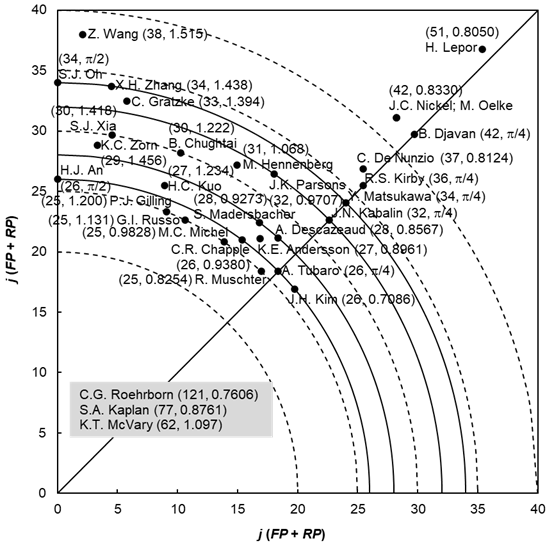
Figure 4: Top 32 authors with Y-index (j ≥ 25).
Authors sharing the same j value but differing in h (authorship distribution) were plotted along the same circular arc. For example, four authors with j=26, H.J. An (π/2), C.R. Chapple (0.9380), A. Tubaro (π/4), and J.H. Kim (0.7086), had varying authorship profiles, reflecting differing emphasis on first versus corresponding authorship. A similar trend was observed among authors with j=25, such as P.J. Gilling (1.200), G.I. Russo (1.131), M.C. Michel (0.9828), and R. Muschter (0.8254). While their productivity levels were similar, the h values illustrated different publication strategies.
The diagonal line in the Y-index plot (h=π/4) represents authors with equal numbers of first- and corresponding-author articles. Prominent examples include B. Djavan (42), R.S. Kirby (36), Y. Matsukawa (34), J.N. Kabalin (32), and A. Tubaro (26). Djavan led this group with the highest j value. Overall, the Y-index provides a nuanced representation of author productivity and scholarly behaviour, enabling a clearer distinction between publication quantity and authorship roles. Finally, two Nobel laureates made notable contributions to BPH-related literature:
- Gregg L. Semenza, awarded the 2019 Nobel Prize in Physiology or Medicine for discoveries related to hypoxia inducible factors, co-authored the article “Up-regulation of hypoxia-inducible factor 1α is an early event in prostate carcinogenesis” [66], which received 156 citations (TC2024).
- Andrew V. Schally, recipient of the 1977 Nobel Prize for his work on peptide hormone regulation, authored numerous articles on neuropeptide antagonists. His single-author article “Luteinizing hormone-releasing hormone analogs: Their impact on the control of tumorigenesis” [67] is his most cited BPH-related work, with 193 citations (TC2024). His studies underscored the therapeutic relevance of LH RH agonists and antagonists in the treatment of BPH and other hormone-related conditions.
CONCLUSION
Between 1991 and 2024, a total of 20,813 publications related to Benign Prostatic Hyperplasia (BPH) were indexed in the SCI-EXPANDED database, encompassing 20 distinct document types. Among these, journal articles represented the most common format and were published in 16 different languages. The subject category “Urology and Nephrology” yielded the highest volume of publications, indicating its central role in BPH research. The Journal of Urology emerged as the most prominent and influential journal for BPH-related studies, serving as a key platform for knowledge dissemination. The United States led both in terms of publication volume and citation impact, with the Mayo Clinic ranking as the top institution across five publication types.
In contrast, non-G7 countries and institutions outside the United States generally received fewer citations, highlighting persistent global disparities in research visibility and scholarly influence. International collaboration was found to be positively associated with higher citation rates, emphasizing its importance in extending research impact and enhancing academic recognition. In contrast, non-G7 countries and institutions outside the United States generally received fewer citations, highlighting persistent global disparities in research visibility and scholarly influence. International collaboration was found to be positively associated with higher citation rates, emphasizing its importance in extending research impact and enhancing academic recognition. These findings reveal a marked geographical imbalance in both the production and influence of BPH research. Finally, C.G. Roehrborn was identified as the most prolific and highly cited author in this field, with his substantial body of work significantly shaping the direction and advancement of BPH research.
REFRENCES
- Berry SJ, Coffey DS, Walsh PC, Ewing LL. The development of human benign prostatic hyperplasia with age. J Urol. 1984;132(3):474-479.
[Google Scholar] [PubMed] [Crossref]
- Egan KB. The epidemiology of benign prostatic hyperplasia associated with lower urinary tract symptoms: Prevalence and incident rates. Urol Clin North Am. 2016;43(3):289-297.
[Google Scholar] [PubMed] [Crossref]
- Calais Da Silva F. Benign prostatic hyperplasia: Natural evolution versus medical treatment. European urology. 1997;32(Suppl. 2):34-37.
[Google Scholar] [PubMed] [Crossref]
- McVary KT. BPH: Epidemiology and comorbidities. Am J Manag Care. 2006;12(5 Suppl):S122-S128.
- Rosen R, Altwein J, Boyle P, Kirby RS, Lukacs B, Meuleman E, et al. Lower urinary tract symptoms and male sexual dysfunction: The multinational survey of the aging male (MSAM-7). Eur Urol. 2003;44(6):637-649.
[Google Scholar] [PubMed] [Crossref]
- Blair HA. Hexanic extract of serenoa repens (Permixon®): A review in symptomatic benign prostatic hyperplasia. Drugs Aging. 2022;39(3):235-243.
[Google Scholar] [PubMed] [Crossref]
- Birkhoff JD. Natural history of benign prostatic hypertrophy. Springer New York. 1983;5-9.
- Syms P. Treatment of prostatic hypertrophy. JAMA-J Am Med Assoc. 1901;36(2):99-103.
[Crossref]
- Oberländer FM. The therapy for prostate hypertrophy. Deutsche Medizinische Wochenschrift. 1905;31(29):1137-1141.
- Bouffleur AI. Transvesical cauterization as a substi tute for the bottini operation in the treatment of some forms of prostatic hypertrophy.1. Ann Surg. 1902;36(1):20-43.
[Google Scholar] [PubMed] [Crossref]
- Meyer W. The treatment of prostatic hypertrophy associated with stone in the bladder by means of litholapaxy and bottini's operation at one sitting.1. Ann Surg. 1902;36(1):17-19.
[Google Scholar] [PubMed] [Crossref]
- Hawley GW. I. The surgical problem in prostatic hypertrophy. Ann Surg. 1903;38(5):609.
[Google Scholar] [PubMed] [Crossref]
- Ruth WA. The nursing care in prostatic hypertrophy. Am J Nurs. 1928:1108-1114.
- Hunt VC. Carcinoma of the prostate gland and prostatic capsule developing subsequent to prostatectomy for benign prostatic hypertrophy. J Urol. 1929;22(4):351-362.
- Herman L. Neoplasm of the trigone vesicae: A probable instance of hypertrophic changes in aber rant prostatic tissue. J Urol. 1928;19(3):291-305.
[Crossref]
- Huggins C, Hodges CV. Studies on prostatic cancer: I. The effect of castration, of estrogen and of androgen injection on serum phosphatases in metastatic carcinoma of the prostate. J Urol. 2002;168(1):9-12.
- Benson MC, Whang IS, Pantuck A, Ring K, Kaplan SA, Olsson CA, et al. Prostate specific antigen density: A means of distinguishing benign prostatic hypertrophy and prostate cancer. J Urol. 1992;147(3):815-816.
[Google Scholar] [PubMed] [Crossref]
- McNeal JE. The zonal anatomy of the prostate. The prostate. 1981;2(1):35-49.
- McNeal JE, Redwine EA, Freiha FS, Stamey TA. Zonal distribution of prostatic adenocarcinoma: Correlation with histologic pattern and direction of spread. Am J Surg Pathol. 1988;12(12):897-906.
[Google Scholar] [PubMed] [Crossref]
- Roos NP, Wennberg JE, Malenka DJ, Fisher ES, McPherson K, Andersen TF, et al. Mortality and reoperation after open and transurethral resection of the prostate for benign prostatic hyperplasia. N Engl J Med. 1989;320(17):1120-1124.
[Google Scholar] [PubMed] [Crossref]
- Timms BG, Hofkamp LE. Prostate development and growth in benign prostatic hyperplasia. Differentiation. 2011;82(4-5):173-183.
[Google Scholar] [PubMed] [Crossref]
- Reichelt AC, Suarez-Ibarrola R, Herrmann TR, Miernik A, Schöb DS. Laser procedures in the treatment of BPH: A bibliometric study. World J Urol. 2021;39(8):2903-2911.
[Google Scholar] [PubMed] [Crossref]
- Cruz AP, Zhu KY, Ellimoottil C, Dauw CA, Sarma A, Skolarus TA. Characterizing the benign prostatic hyperplasia literature: A bibliometric analysis. Urology. 2020;136:202-211.
[Google Scholar] [PubMed] [Crossref]
- Ho YS, Mukul SA. Publication performance and trends in mangrove forests: A bibliometric analysis. Sustainability. 2021;13(22):12532.
- Ho YS, Al-Moraissi EA, Christidis N, Christidis M. Evolving trends in dental education: A bibliometric analysis of research outputs, challenges and innovations (1991-2023). Cogent Educ. 2025;12(1):2453259.
- Ming HW, Hui ZF, Yuh SH. Comparison of universities’scientific performance using bibliometric indicators. J Libr Inf Sci. 2011;16(2):1-9.
- Ho YS. Classic papers published by Taiwanese scientists in the science citation index expanded: A bibliometric study. Collnet J Scientomet. 2018;12(1):83-95.
- Mohsen MA, Fu HZ, Ho YS. A bibliometric analysis of linguistics publications in the Web of Science. J Sci Res. 2017;6(2):109-118.
- Ho YS, Kahn M. A bibliometric study of highly cited reviews in the science citation index expanded™. J Assoc Inf Sci Technol. 2014;65(2):372-385.
- Ho YS, Tapolyai M, Cheungpasitporn W, Fülöp T. A bibliometric analysis of publications in renal failure in the last three decades. Ren Fail. 2023;45(2):2241913.
[Google Scholar] [PubMed] [Crossref]
- Wang MH, Ho YS. Research articles and publication trends in environmental sciences from 1998 to 2009. Arch Environ Sci. 2011;5:1-10.
- Chong Y, Long X, Ho YS. Scientific landscape and trend analysis of keloid research: A 30-year bibliometric review. Ann Transl Med. 2021;9(11):945.
[Google Scholar] [PubMed] [Crossref]
- Farooq M, Khan AU, El-Adawy H, Mertens-Scholz K, Khan I, Neubauer H, et al. Research trends and hotspots of Q fever research: A bibliometric analysis 1990‐2019. Biomed Res Int. 2022;2022(1):9324471.
[Google Scholar] [PubMed] [Crossref]
- Al-Moraissi EA, Christidis N, Ho YS. Publication performance and trends in temporomandibular disorders research: A bibliometric analysis. J Stomatol Oral Maxillofac Surg. 2023;124(1):101273.
[Google Scholar] [PubMed] [Crossref]
- Chiu WT, Ho YS. Bibliometrics of Latin American research on COVID-19 in the first year of the pandemic: The main trends. Revista de Biología Tropical. 2021;69(4):1306-1321.
[Crossref]
- Ho YS, Lwesya F. Classic publications in food security research: A bibliometric analysis. World Food Policy. 2024;10(1):143-161.
- Li Z, Ho YS. Use of citation per publication as an indicator to evaluate contingent valuation research. Scientometrics. 2008;75(1):97-110.
- Ho YS, Fülöp T, Krisanapan P, Soliman KM, Cheungpasitporn W. Artificial intelligence and machine learning trends in kidney care. Am J Med Sci. 2024;367(5):281-295.
[Google Scholar] [PubMed] [Crossref]
- Chiu WT, Ho YS. Bibliometric analysis of tsunami research. Scientometrics. 2007;73(1):3-17.
- Ho YS, Giordano V, Mauffrey C, Giannoudis PV. Trends of impact factor contributors to the Injury Journal: A bibliometric analysis. Injury. 2024;55(3):111255.
[Google Scholar] [PubMed] [Crossref]
- Ho YS, Giordano V, Mauffrey C, Giannoudis PV. Trends of impact factor contributors to the Injury Journal: A bibliometric analysis. Injury. 2024;55(3):111255.
[Google Scholar] [PubMed] [Crossref]
- Vega-Arce M, Salas G, Núñez-Ulloa G, Pinto-Cortez C, Fernandez IT, Ho YS. Research performance and trends in child sexual abuse research: A science citation index expanded-based analysis. Scientometrics. 2019;121(3):1505-1525.
- Ranasinghe P, Monge-Nájera J, Liyanage CK, Ho YS. Half a century of Sri Lanka research: Subjects, researchers, institutions, journals and impact (1973-2019). Revista de Biología Tropical. 2022;70(1):40-52.
- Wambu EW, Fu HZ, Ho YS. Characteristics and trends in global tea research: A science citation index expanded-based analysis. Int J Food Sci Technol. 2017;52(3):644-651.
- Chuang KY, Ho YS. A bibliometric analysis on top-cited articles in pain research. Pain Med. 2014;15(5):732-744.
[Google Scholar] [PubMed] [Crossref]
- Ho YS. Top-cited articles in chemical engineering in Science Citation Index Expanded: A bibliometric analysis. Chin J Chem Eng. 2012;20(3):478-488.
- Ho YS. The top-cited research works in the Science Citation Index Expanded. Scientometrics. 2013;94(3):1297-1312.
- Cheungpasitporn W, Krisanapan P, Suppadungsuk S, Thongprayoon C, Fülöp T, Miao J, et al. Research trends and performance of endothelin A receptor antagonist in kidney care: A bibliometric analysis. Ren Fail. 2025;47(1):2487212.
[Google Scholar] [PubMed] [Crossref]
- Monge-Nájera J, Ho YS. El Salvador publications in the Science Citation Index Expanded: Subjects, authorship, collaboration and citation patterns. Rev biol trop. 2017;65(4):1428-1436.
- Barry MJ, Fowler Jr FJ, O’Leary MP, Bruskewitz RC, Holtgrewe HL, Mebust WK, et al. The American Urological Association symptom index for benign prostatic hyperplasia. J Urol. 1992;148(5):1549-1557.
[Google Scholar] [PubMed] [Crossref]
- Giannoudis PV, Chloros GD, Ho YS. A historical review and bibliometric analysis of research on fracture nonunion in the last three decades. Int Orthop. 2021;45(7):1663-1676.
[Google Scholar] [PubMed] [Crossref]
- Long X, Huang JZ, Ho YS. A historical review of classic articles in surgery field. Am J Surg. 2014;208(5):841-849.
[Google Scholar] [PubMed] [Crossref]
- Kappe CO. Biologically active dihydropyrimidones of the biginelli-type-a literature survey. Eur J Med Chem. 2000;35(12):1043-1052.
[Google Scholar] [PubMed] [Crossref]
- Ho YS, Satoh H, Lin SY. Japanese lung cancer research trends and performance in Science Citation Index. Internal Medicine. 2010;49(20):2219-2228.
[Google Scholar] [PubMed] [Crossref]
- Usman M, Ho YS. A bibliometric study of the Fenton oxidation for soil and water remediation. J Environ Manage. 2020;270:110886.
[Google Scholar] [PubMed] [Crossref]
- Ho YS, Siu E, Chuang KY. A bibliometric analysis of dengue-related publications in the Science Citation Index Expanded. Future Virol. 2016;11(9):631-648.
- Li Y, Wang X, Thomsen JB, Nahabedian MY, Ishii N, Rozen WM, et al. Research trends and performances of breast reconstruction: A bibliometric analysis. Ann Transl Med. 2020;8(22):1529.
[Google Scholar] [PubMed] [Crossref]
- McConnell JD, Roehrborn CG, Bautista OM, Andriole Jr GL, Dixon CM, Kusek JW, et al. The long-term effect of doxazosin, finasteride, and combination therapy on the clinical progression of benign prostatic hyperplasia. N Engl J Med. 2003;349(25):2387-2398.
[Google Scholar] [PubMed] [Crossref]
- Rosen R, Altwein J, Boyle P, Kirby RS, Lukacs B, Meuleman E, et al. Lower urinary tract symptoms and male sexual dysfunction: The Multinational Survey of the Aging Male (MSAM-7). Eur Urol. 2003;44(6):637-649.
[Google Scholar] [PubMed] [Crossref]
- Ho YS. A bibliometric analysis of highly cited publications in Web of Science category of emergency medicine. Signa Vitae. 2021;17(1):11-19.
- Riesenberg D, Lundberg GD. The order of authorship: Who's on first?. Jama. 1990;264(14):1857.
[Google Scholar] [PubMed] [Crossref]
- Fu HZ, Ho YS. Collaborative characteristics and networks of national, institutional and individual contributors using highly cited articles in environmental engineering in Science Citation Index Expanded. Curr Sci. 2018;115(3):410-421.
- Shariat SF, Ashfaq R, Roehrborn CG, Slawin KM, Lotan Y. Expression of survivin and apoptotic biomarkers in benign prostatic hyperplasia. J Urol. 2005;174(5):2046-2050.
[Google Scholar] [PubMed] [Crossref]
- Crawford ED, Wilson SS, McConnell JD, Slawin KM, Lieber MC, Smith JA, et al. Baseline factors as predictors of clinical progression of benign prostatic hyperplasia in men treated with placebo. J Urol. 2006;175(4):1422-1427.
[Google Scholar] [PubMed] [Crossref]
- Roehrborn CG. Rationale for the inclusion of alpha-adrenergic blockade in benign prostatic hyperplasia treatment guidelines. European urology. 1996;29(Suppl. 1):40-48.
- Zhong H, Semenza GL, Simons JW, De Marzo AM. Up-regulation of hypoxia-inducible factor 1α is an early event in prostate carcinogenesis. Cancer Detect Prev. 2004;28(2):88-93.
[Google Scholar] [PubMed] [Crossref]
- Schally AV. Luteinizing hormone-releasing hormone analogs: Their impact on the control of tumorigenesis☆. Peptides. 1999;20(10):1247-1262.
[Google Scholar] [PubMed] [Crossref ]
Author(s) Info
1 Division of Urology, Shin-Kong Wu Ho-Su Memorial Hospital, Taipei, Taiwan2 School of Medicine, Fu-Jen Catholic University, New Taipei City, Taiwan
3 Department of Anesthesiology, Taipei Veterans General Hospital and National Yang-Ming University School of Medicine, Taipei, Taiwan
4 CT HO Trend, Taipei, Taiwan
Received date: 01-Sep-2025, Manuscript No: JNP-25-165631; Accepted date: 24-Sep-2025 Published date: 14-Oct-2025
Citation: Juang GD, Lin SM, Ho YS. (2025) Publication Performance in Benign Prostatic Hyperplasia Research between 1991-2024: A Bibliometric Analysis. J Nephrol.1: 003.
Copyright: © 2025 Juang GD, et al. This is an open-access article distributed under the terms of the Creative Commons Attribution License, which permits unrestricted use, distribution, and reproduction in any medium, provided the original author and source are credited.